
Artificial intelligence is no longer a technology of the future. It is here, it is accessible, and businesses across the Northern Territory are already making decisions about it — whether they realise it or not.
Every time a staff member uses Microsoft Copilot to draft a report, asks ChatGPT to summarise a document, or relies on an automated scheduling tool, they are using AI. The question is no longer whether your organisation will adopt AI. The question is whether you will do so intentionally, strategically, and responsibly.
This article is for business owners, managers and leaders across Darwin, Alice Springs and regional NT who want a practical, plain-English guide to getting AI right in 2026.
The Reality Check: AI Is Already in Your Business
Before we talk about adoption strategy, let's be honest about where things stand. Most NT businesses are already using AI tools — just not always with a plan. Your receptionist might be using an AI-powered scheduling assistant. Your accountant's software likely uses machine learning to flag anomalies.
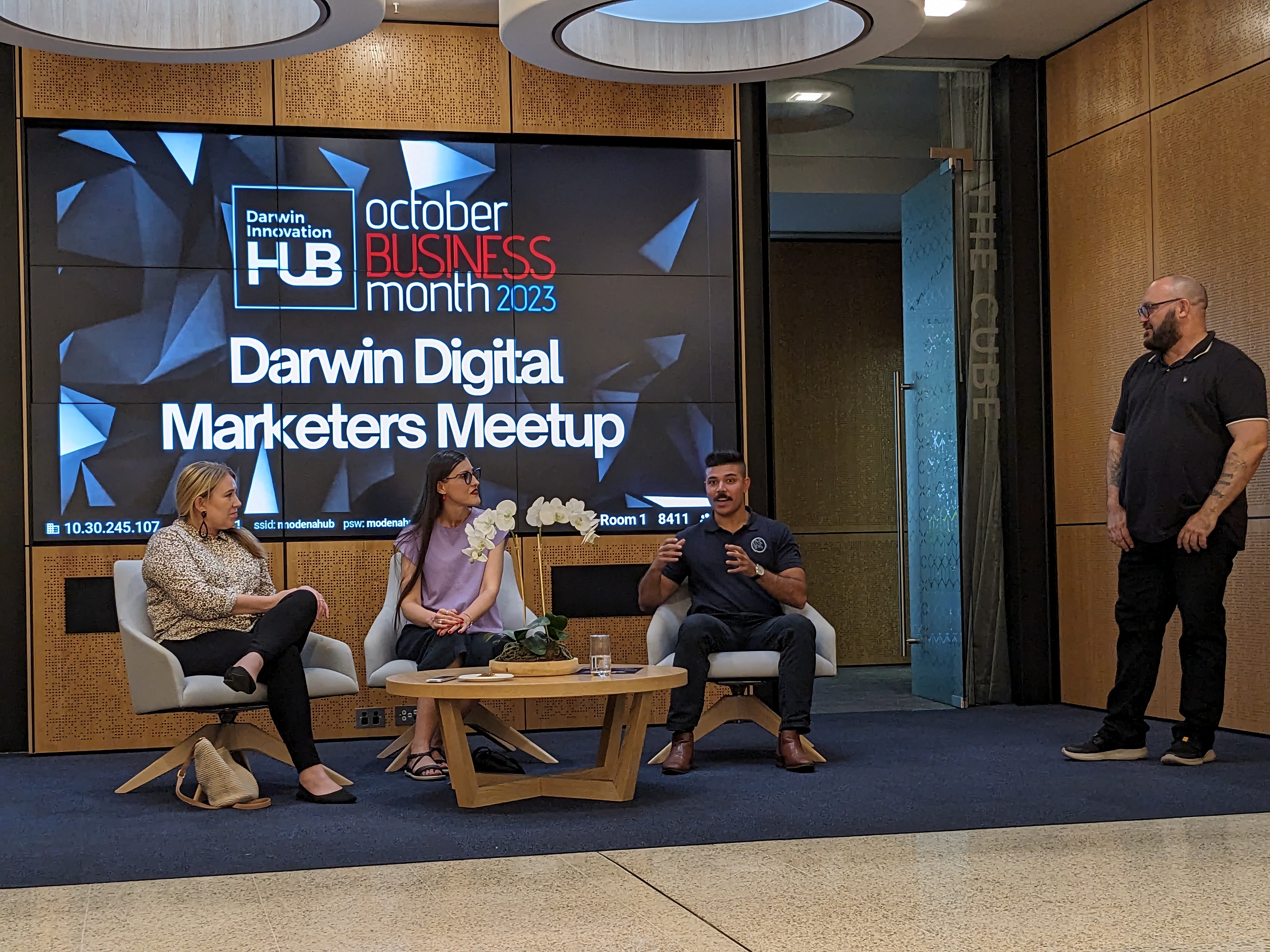
Rifat speaking on a technology panel discussing AI adoption for NT businesses.
What AI Actually Is (and Isn't)
When most businesses talk about AI in 2026, they are typically referring to one or more of the following:
- Generative AI — tools like Microsoft Copilot, ChatGPT, and Google Gemini that can write, summarise, translate, and generate content based on prompts.
- Automation AI — systems that complete repetitive tasks without human intervention.
- Predictive AI — tools that analyse historical data to forecast outcomes, like customer churn or cash flow trends.
- Computer Vision — AI that interprets images or video, used in security systems or quality control.
Step 1: Audit What You're Already Using
Before you introduce anything new, take stock of what is already in your environment. A simple AI inventory answers three questions:
What AI tools are already active in your business?
Survey your team. You will almost certainly discover AI-powered features inside tools you already pay for.
What data is being accessed by these tools?
Understanding what data each tool can access is critical before you assess the risk profile of your current stack.
Who approved these tools and on what basis?
Knowing where the gaps are in your governance is the starting point for building better controls.
Step 2: Start Small and Solve Real Problems
Start with problem-first adoption — a specific operational pain point — and ask whether AI could address it.
Use Microsoft Copilot to draft client correspondence and proposal documents. A good typist saves 20 minutes per document. Copilot can save an hour.
Deploy an AI chatbot on your website to handle FAQs and booking enquiries outside business hours.
Use AI-powered scheduling tools to reduce double-booking and automate job status updates.
Leverage AI writing tools to produce grant applications and impact reports faster.
Use AI to analyse survey data and draft policy documents. Keep humans in the loop for decisions that affect people.
Step 3: Get Serious About Data and Privacy
This is where responsible adoption separates from reckless adoption. AI tools typically send your inputs to a remote server, and those inputs may be used to improve the model's training data.
The relevant legal frameworks are the Australian Privacy Act 1988 and the Notifiable Data Breaches Act 2017. Use enterprise-grade AI tools and write a simple AI Acceptable Use Policy for your team.
Step 4: Train Your People — Not Just Your Systems
The biggest driver of AI failure in small and medium businesses is not technology. It is people. Responsible AI adoption requires investment in your team.

True Blue IT Services team at the CDU IT Code Fair — building digital capability across the NT.
At CodeUp NT, we have seen firsthand how quickly people develop AI confidence when given practical, hands-on exposure in a low-stakes environment.
Step 5: Measure What Matters
AI adoption without measurement is just technology spend. Three principles for measuring AI ROI:
- Baseline first. Record the current state of the metric you are trying to improve.
- Be patient. Give any new tool a genuine 90-day runway before drawing conclusions.
- Measure cost, not just benefit. Include training time and prompt refinement in your ROI calculation.
Responsible AI in the NT Context
Cultural sensitivity in AI outputs
Always have Indigenous staff or community members review AI-generated content about Aboriginal and Torres Strait Islander communities.
Connectivity constraints in remote areas
For businesses operating in remote NT, build offline fallbacks into any process relying on cloud-based AI tools.
Supporting local technology capability
Invest in local AI skills — through supporting CodeUp NT graduates or partnering with Charles Darwin University.
Where to Start This Week
Pick one repetitive writing task and practice using ChatGPT or Microsoft Copilot to produce a first draft.
Conduct an AI inventory. Write a one-page AI Acceptable Use Policy.
Engage an IT advisor to conduct a proper AI readiness assessment and pilot project.
Closing Thoughts
AI is not going to replace the relationships and human touch that make Territory businesses distinctive. But used thoughtfully, it can free up real time and give your team the space to do the work that actually matters.
If you would like to talk through what responsible AI adoption could look like for your organisation, I am always happy to have that conversation.
Written by

Rifat works with businesses, government agencies and community organisations across the Northern Territory to implement practical technology solutions that drive real results.